SEAM INTELLIGENCE REPORT NO. 1 — JULY 2026
We Asked Four AI Engines to Name the Best On-Model Fashion AI Tools. They Barely Agreed.
SEAM’S TAKE
AI engines don’t agree on which on-model fashion AI tools are worth recommending — and the reason has almost nothing to do with the products themselves. What determines AI visibility in this category is almost entirely a content infrastructure question: who has written about you, in what format, and whether a competitor thought to include you in their roundup. The fashion industry is not yet part of this conversation.
The Question
When a fashion brand asks an AI engine: “What are the best AI tools for on-model fashion image generation?” — it expects a reasonably objective answer.
But are AI engines recommending the same companies? And what information are those recommendations actually based on?
Rather than evaluating which platform is technically strongest, this report examines which companies become visible to AI — and why.
Key Findings
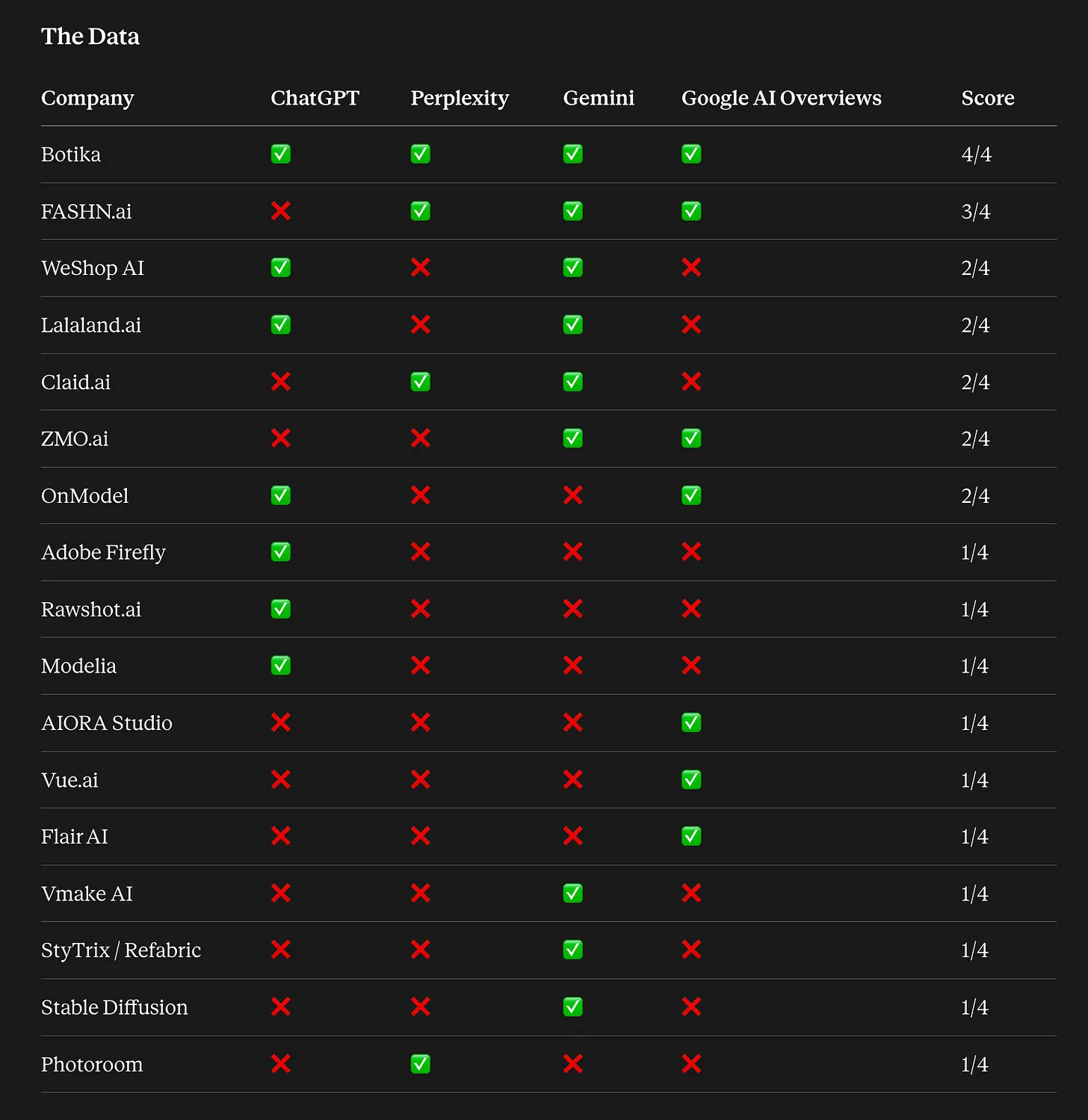
- 17 companies were recommended across four AI engines. Only one — Botika — appeared in all four.
- Only 2 of 17 companies appeared in 3 or more engines. 10 appeared in just one.
- The dominant citation sources were competitor platforms and AI comparison sites. Traditional fashion media contributed zero citations.
- Gemini recommended the most companies (9). Perplexity the fewest (4).
- FASHN.ai was recommended by 3 of 4 engines but was completely absent from ChatGPT.
- ZMO.ai appeared in two engines with no traceable citation — recommended from model memory alone.
- AIORA Studio achieved a recommendation based entirely on its own three blog posts.
Methodology
- Same prompt submitted to ChatGPT, Gemini, Perplexity, and Google AI Overviews
- Every recommended company recorded
- Every cited source traced to its original publication
- Citation sources classified by publisher type
- No sponsored placements, affiliate relationships, or paid rankings
Finding 01: There Is No Consensus — Only One Company Cleared All Four Engines
Of the 17 companies recommended across all engines, only Botika appeared in all four. FASHN.ai came second at 3/4. Every other company was recommended by two engines at most, and 10 of the 17 appeared in only a single engine.
A fashion brand running this prompt on ChatGPT and a brand running it on Perplexity would receive almost entirely different vendor shortlists. There is no universal AI view of this category. There are four separate ones.
The number of companies each engine recommended also varied significantly. Gemini cast the widest net at nine companies. Perplexity was the most selective at four. ChatGPT and Google AI Overviews each recommended seven, but with minimal overlap in which seven they chose.
Finding 02: The Recommendations Are Built on Competitor Content
The citations behind the recommendations reveal something more significant than the recommendations themselves — where AI engines are actually learning from.
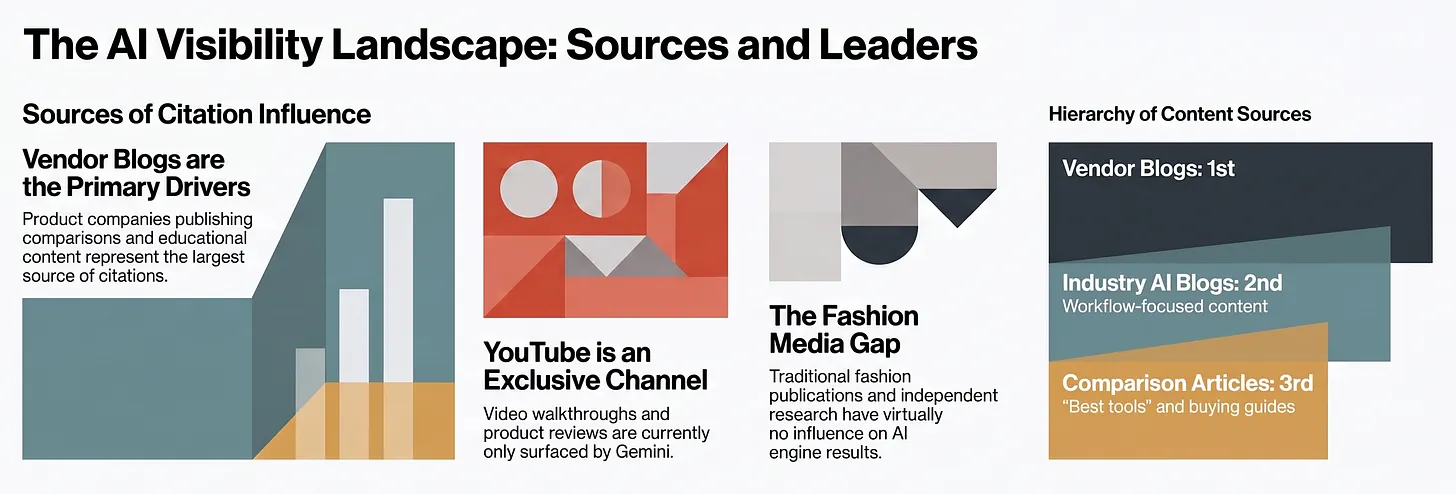
The dominant citation sources across all four engines were competitor platforms writing about the category. Not the brands’ own marketing, not independent reviewers, and not fashion media.
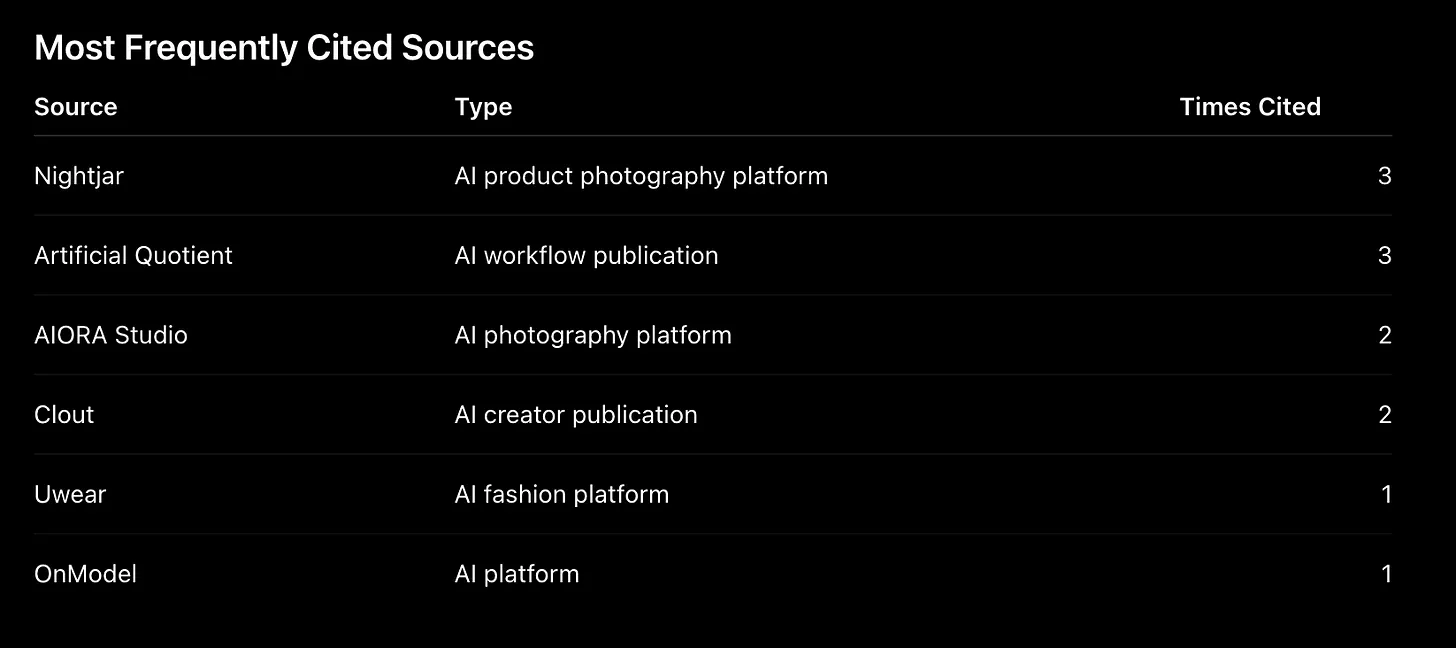
Nightjar, an AI product photography company, was among the most cited sources, appearing in multiple Perplexity recommendations. OnModel, itself a platform in the category, authored content that shaped both FASHN.ai and Modelia’s recommendations. Mock It Up and Wearview — direct competitors of Botika — both published articles that supported Botika’s recommendations on Google AI Overviews.
The second major citation category was AI comparison and workflow sites — Clout, Artificial Quotient, Gitnux, and Worldmetrics — operating adjacent to but outside the fashion industry. Tom’s Guide was the only publication resembling mainstream media in any citation. Traditional fashion publications were completely absent.
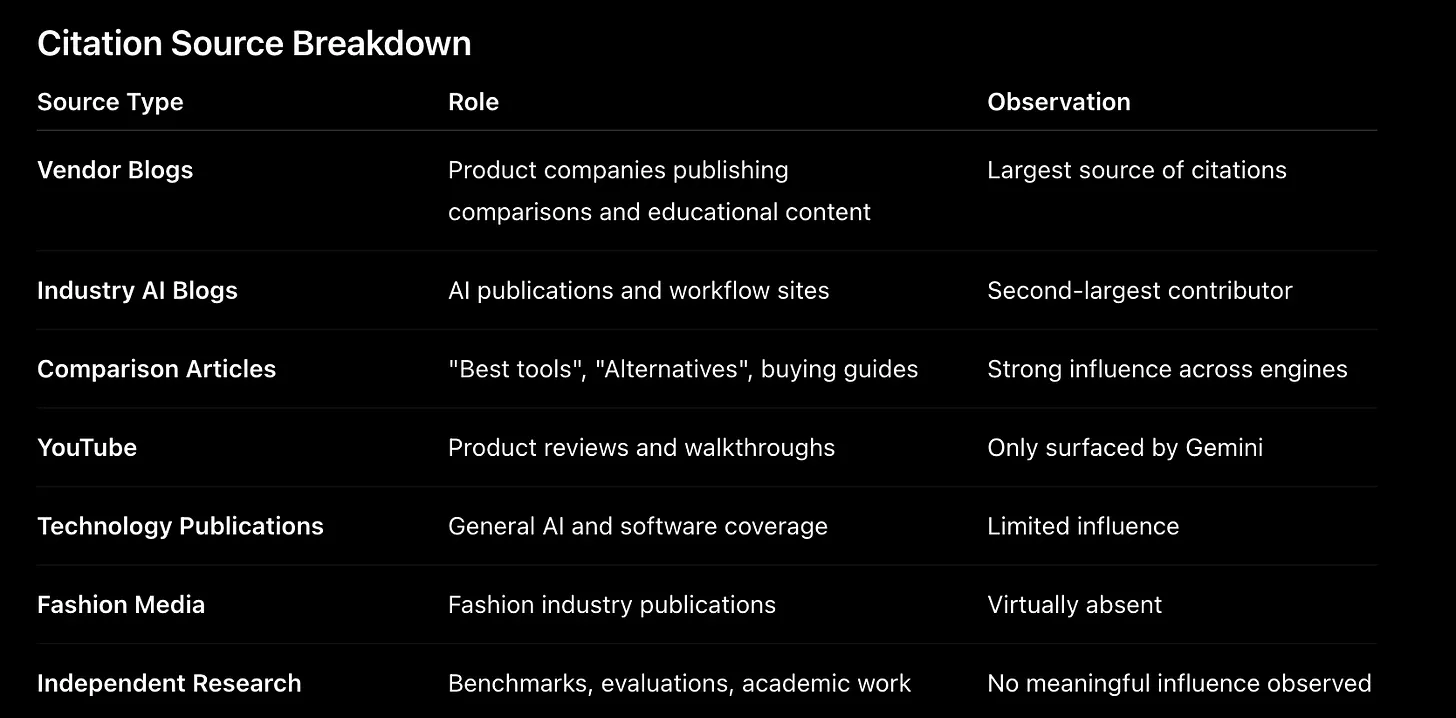
What this tells us: Vendor-generated educational content currently has greater influence over AI recommendations than independent product evaluations. Comparison articles have become one of the primary pathways through which products enter AI recommendations. The information ecosystem — not just the product — is shaping visibility.
Finding 03: Being in a Competitor’s Article May Matter More Than Your Own
Botika’s 4/4 score is supported by nine distinct citation sources. Of those nine, the majority are competitor platforms or vendor comparison articles — not Botika’s own content.
Companies that invested in building visibility through competitor roundups and external editorial coverage ended up with the strongest AI presence — regardless of what their own website says.
This represents a meaningful shift in how discoverability works. Being named in a competitor’s alternatives page or a best-tools roundup by another platform now appears to carry more citation weight than publishing another feature update on your own blog.
Finding 04: Every AI Engine Thinks Differently
The same prompt, submitted to four engines, produced four distinct outputs — not just in which companies appeared, but in how the recommendation was constructed.
ChatGPT recommended seven companies but was the only engine to omit FASHN.ai entirely — a notable absence given that FASHN.ai appeared across Perplexity, Gemini, and Google AI Overviews. ChatGPT’s citations leaned toward broader AI tools and smaller platforms with active own-brand content.
Gemini produced the widest list at nine companies and was the only engine to recommend Stable Diffusion — a general-purpose open-source model — in response to a prompt asking for commercial software. It was also the only engine to pull from YouTube. Gemini appeared to draw from the broadest range of content types.
Perplexity returned the most selective list at four companies. Its citations traced consistently to detailed comparison content from companies with established products. Unlike other engines, Perplexity did not surface lightweight comparison directories.
Google AI Overviews showed the clearest preference for commercial comparison content. Three of the seven companies it recommended — AIORA Studio, Vue.ai, and Flair AI — appeared in no other engine. AIORA Studio’s entry was supported entirely by its own three blog posts.
Finding 05: Visibility Without Citations Is Real — and Harder to Track
ZMO.ai appeared in both Gemini and Google AI Overviews with no traceable citation. The recommendations appeared to be drawn from model memory rather than retrieved content.
This matters because it represents a category of visibility that doesn’t follow the citation logic governing everything else in this report. A company that trained on strong early web presence or press coverage may have embedded itself in model weights independently of what any comparison article says about it today. That visibility is real — but it’s also opaque, and it can’t be directly engineered through content strategy.
What’s Missing
The data also reveals what AI recommendations don’t currently capture.
Fashion media has almost no influence. Publications that cover AI in fashion extensively contributed zero citations to AI engine recommendations in this category.
Independent evaluation is missing. Every citation traced back to a vendor, a competitor, or a comparison site with commercial interests. There is no neutral third-party benchmarking influencing what AI recommends.
Visibility is not capability. The companies recommended most consistently are not necessarily the most technically advanced. The structure and distribution of supporting content is shaping AI recommendations as much as product quality.
What This Means
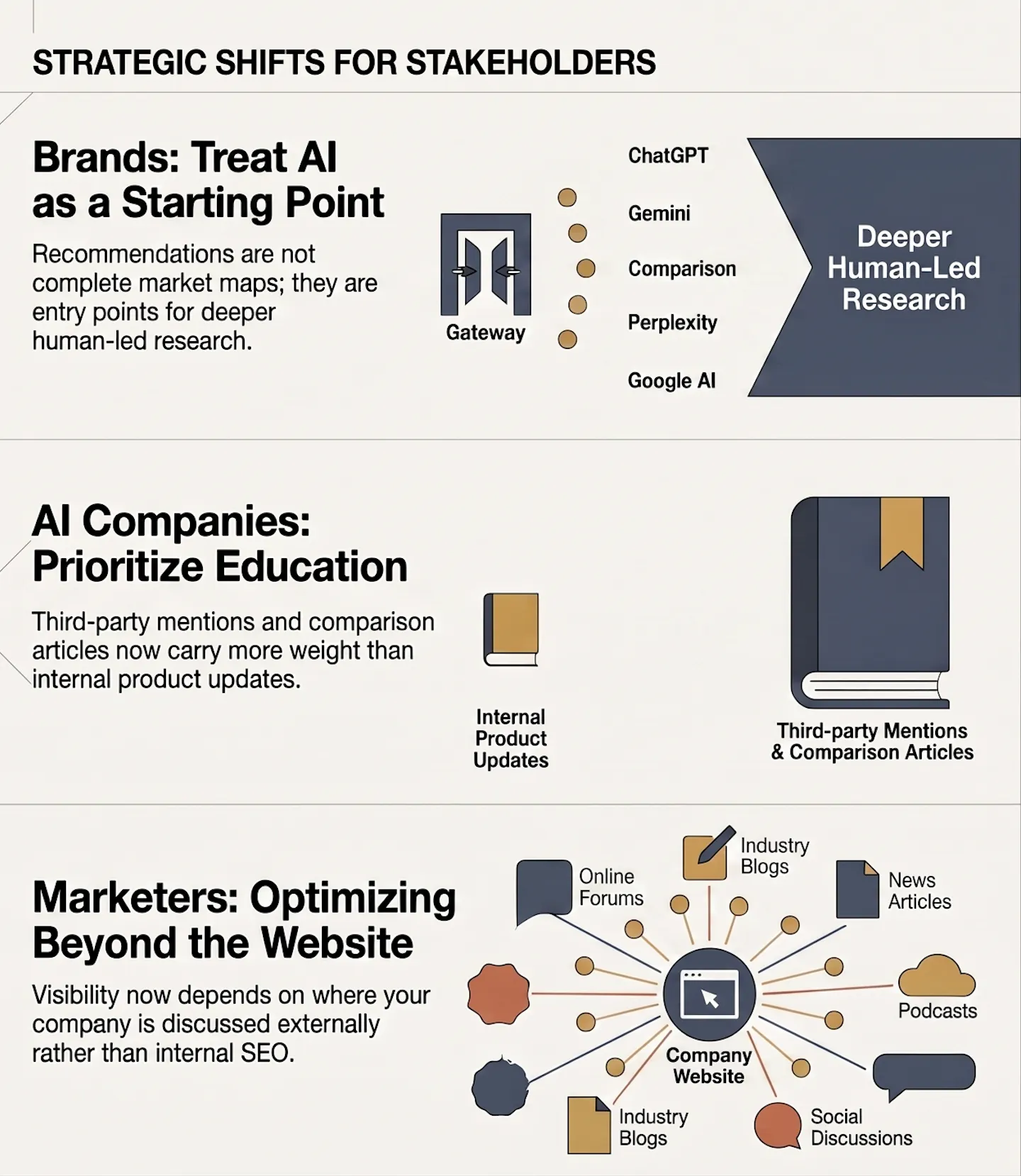
For fashion brands: AI recommendations should be treated as a starting point, not a complete market map. Running the same query across multiple AI engines produces materially different vendor shortlists.
For AI companies: Being recommended by a competitor or included in a third-party comparison article appears to carry more citation weight than publishing content on your own platform. The information ecosystem around your product is as important as the product page itself.
For marketers: Optimising for AI recommendations is becoming distinct from traditional SEO. Visibility increasingly depends on where your company is discussed — not just what your own website says.
About This Report
The Fashion AI Visibility Report is Seam’s ongoing intelligence series examining how AI engines discover, cite, and recommend AI tools for the fashion industry. Rather than ranking products, the report tracks how AI-generated recommendations evolve over time and how the citation ecosystem changes.
Volume 2 will revisit the same prompt using the next generation of AI models to measure how recommendation patterns shift.
Stay ahead of what AI recommends next.
The Seam Brief covers AI adoption in fashion — weekly.
Subscribe on Substack →